‘A stain on Ireland’s conscience’
Identification to begin of 796 bodies buried at children’s home
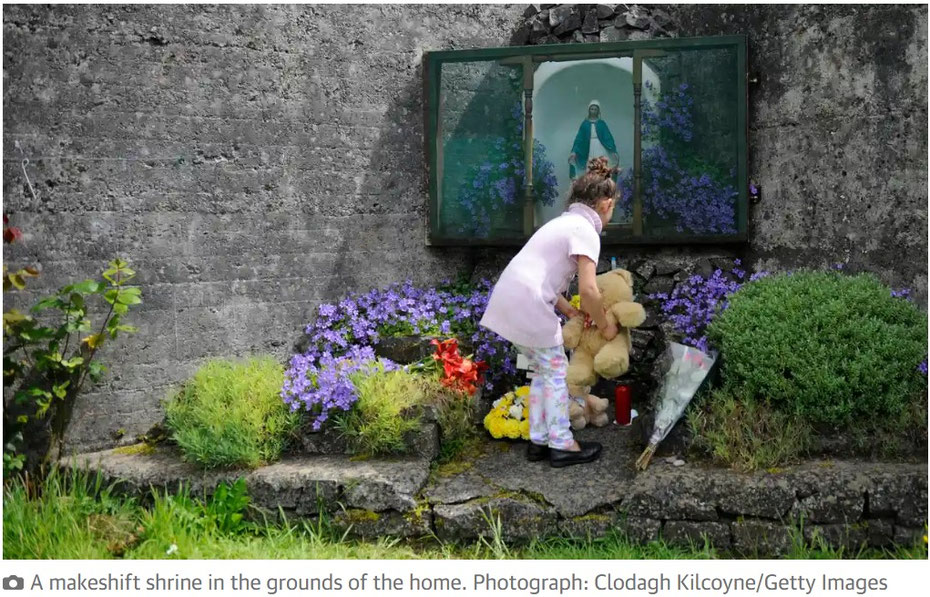
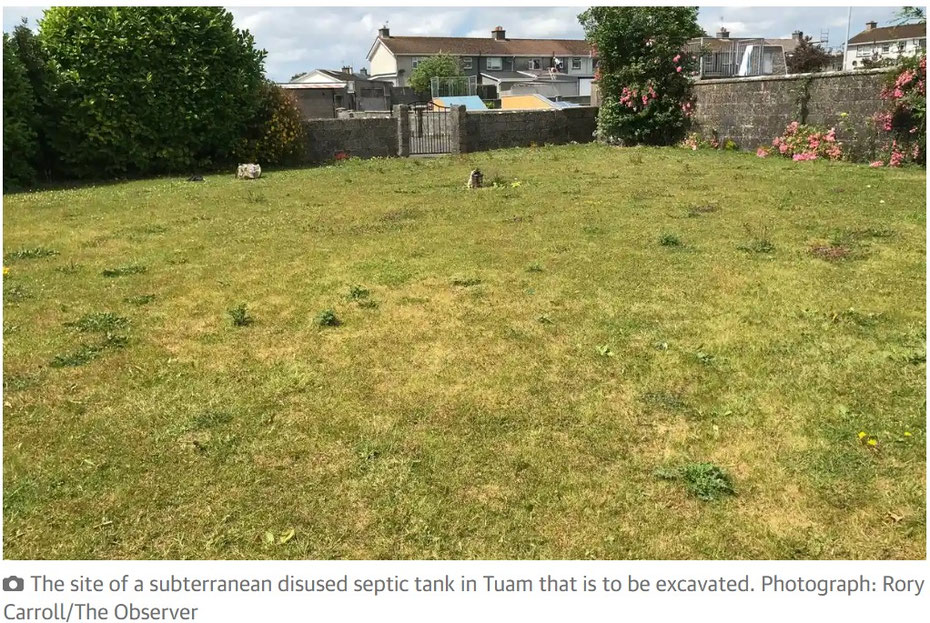
On a balmy summer day, the site of the children’s mass grave in Tuam appears deceptively bucolic. There are no crosses or tombstones in the walled patch of grass. Butterflies flit over shrubs. Robins cheep from branches. It’s peaceful.
“They are two-feet down from where we are standing,” Catherine Corless said. “The bones have mingled together and water got in and thrashed them around. But they’re there.”
Corless is the local historian who a decade ago alerted Ireland, and the world, to a shocking truth about this Galway town: for decades an institution for unmarried mothers put the remains of dead babies and children in a disused subterranean septic tank.
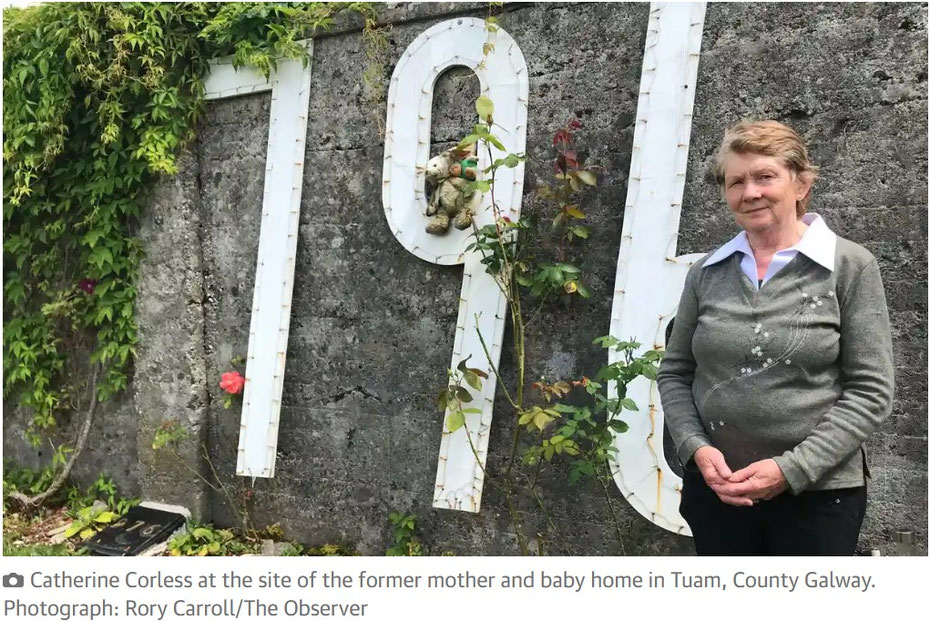
Corless found that, between 1925 and 1961, 796 children died at the St Mary’s mother and baby home, run by nuns from the Bon Secours order – but there were no burial records. Many are believed to have ended up in the former sewage facility. “It became a handy way to dispose of them,” Corless told the Observer. “They didn’t have to account for the deaths. They didn’t want anyone to know. All this time those poor little remains were disintegrating.”
The bones, and their secrets, are to be excavated. A team of forensic investigators led by Daniel Mac Sweeney, a former International Committee of the Red Cross envoy, has been tasked with exhuming, analysing and identifying the remains.
“There has been nothing on this scale before in Ireland,” Roderic O’Gorman, the children’s minister, said in an interview. “This will be one of the most complex operations of its kind in the world.”
The age of the remains, the fact they are children and have been exposed to water will complicate analysis and identification. The excavation team will be independent but is legally obliged to use advanced techniques to match DNA samples with living relatives, said O’Gorman. “Anything that can be done will be done.”
The goal is to give a respectful burial to all the remains, he said. “I’ve always regarded Tuam as a stain on our national conscience. The fact that infant remains were treated so callously even in death is deeply disturbing.”
The home in Tuam was part of a network of institutions for unmarried mothers and their children that doubled as orphanages and adoption agencies for much of the 20th century. They were run by religious orders with sanction by the state, which overlooked deprivation, misogyny, stigma and high infant mortality rates. The government made a formal state apology in 2021 after a judicial commission report.
Tuam – whose name is derived from a Latin term for burial mound – evokes special shame.
Corless, 68, remembers encountering children from the home when she was a child. They were considered embodiments of sin and looked down upon. As a trick Corless, aged around seven, gave one of them a stone wrapped in a sweet paper. The girl grabbed it, expecting a treat. The memory haunts Corless. “Those kids had absolutely nothing. I remember the actual hurt on her face.”
The home closed in 1961, was demolished and replaced with a housing estate. In 1975 two boys foraging for apples stumbled across human bones in the abandoned septic tank. Authorities took no action. Some suggested they were remains from the 1840s famine.
Corless, a former textile factory secretary with an interest in local history, began investigating the site. The Bon Secours order and local authorities fobbed her off but she amassed death certificates and information about the septic tank. National and international media seized on her research in 2014, prompting an official investigation. DNA samples taken in 2016 confirmed the remains dated from the Bon Secours occupancy of the site.
Hunger and neglect afflicted the children, said Corless. “The children were treated as commodities. The prettier babies were set up for adoption – it was a money-making racket. The sicker ones were put away and allowed to die.”
Corless, a mother of four adult children, resisted efforts to leave the remains in place and to memorialise the site with a plaque. “Let them rest in peace? It was a sewage facility – get them out of there. Let’s expose the raw truth of what happened. You have to unearth the whole place to undo the damage. The people of Ireland need to know what happened.”
The Catholic church’s attempt to deny and minimise what happened left her cold. “It turned me totally against the church. They turned their back on me and told lies.”
She hopes the excavation will shed light on how many were placed in the septic tank and the causes of death, and also lead to DNA matches with relatives and former residents of the home, paving the way for proper burials.
Mac Sweeney, who was appointed in May, recently met Corless at the site but has not disclosed when the excavation will begin. Relatives hope it will be in the coming months.
Geoff Knupfer, a former Manchester detective who headed a commission to locate bodies of people “disappeared” during the Troubles, said the dig will probably involve archaeologists, anthropologists, investigators and site managers.
Not all remains will necessarily yield a positive DNA match, requiring careful management to avoid disputes about the ownership and fate of some remains, he warned. “I fear this could prove something of a minefield. This process would be followed by coroners’ inquests and the release of remains to families – another potentially difficult area.”
Corless has received multiple awards and featured in documentaries. The actor Liam Neeson visited her and is to make a dramatised film about her investigation.
In lieu of tombstones at the site locals have erected a number, 796. PJ Haverty, a former resident of the home, also posted a note: “This is what Catholic Ireland did. Took the babies away from their mothers and when they passed away dumped their little bodies into a dirty tank. My God.”
The Guardian (Observer) Online 25 Jun 2023 UK Edition
Rory Carroll in Tuam, County Galway@rorycarroll72
Sun 25 Jun 2023 07.00 BST
UPDATE 14 APRIL 2025
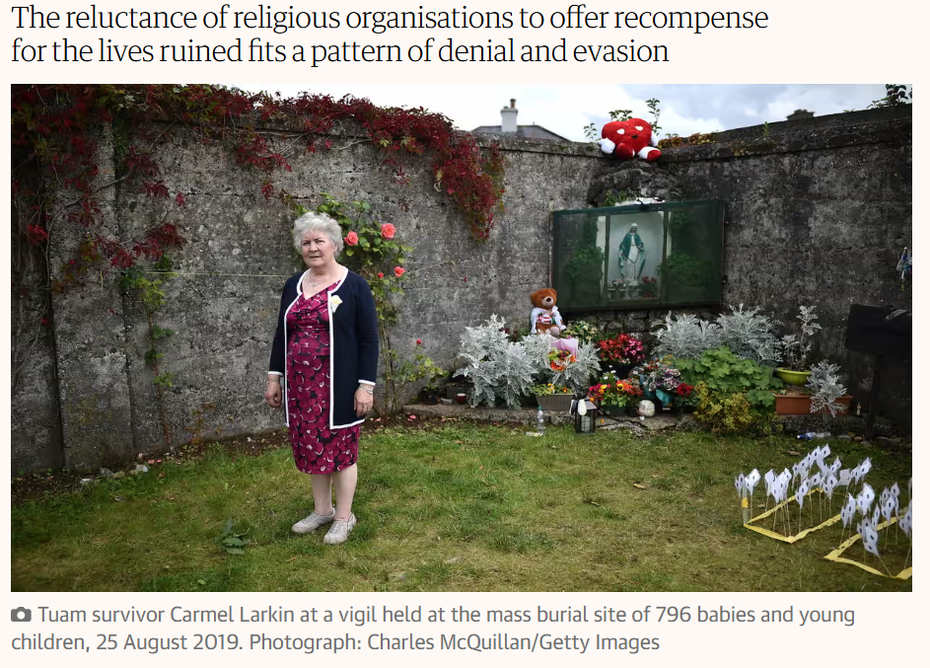
There are some stories so horrifying that their details embed themselves in your flesh and haunt you for the rest of your days. The suffering of the women and babies – an estimated 170,000 of them – who were incarcerated and abused in the Magdalene laundries and mother-and-baby homes that housed “fallen women” is one such story. It is a scandal that is difficult to read about without experiencing an overwhelming feeling of disgust, from the testimonies of abuse and forced adoption, to the mass grave at the former St Mary’s mother-and-baby home near Tuam, County Galway, which contained 796 bodies of babies and children. The nuns put many of them in a septic tank. There were no burial records.
The efforts of survivors, campaigners and historians to bring these stories to light in the face of obstruction and indifference has been the work of decades. The Irish government made a formal apology in 2021 after a judicial commission report. Yet this story, and the human misery it has caused, is not over: the last home closed in 1996. There are living survivors, and people who are descended from the victims. The exhumation of the children’s remains, so that they can be identified if possible and given a proper burial, is continuing. And then there is the question of redress.
This week, it was reported that, of the eight religious organisations linked to Ireland’s mother-and-baby homes, only two have offered to contribute to a survivor redress scheme. The Sisters of Bon Secours – the order that presided over the septic tank mass grave – offered €12.97m (about £11m), while the Daughters of Charity of St Vincent de Paul has proposed contributing a building to the scheme. A third religious body – the Sisters of St John of God – declined to contribute, saying there was “no legal or moral” basis to do so as there was “no evidence that our sisters there acted in any untoward manner”, but offered a donation to survivors.
The other five – the Congregation of Our Lady of Charity of the Good Shepherd, the Congregation of the Sacred Hearts of Jesus and Mary, the Congregation of the Sisters of Mercy, the Legion of Mary and the (Anglican) Church of Ireland – made no offer. They gave various reasons – or excuses, depending on your viewpoint. Ireland’s children’s minister, Norma Foley, expressed her disappointment, saying that, while the state had admitted its role in the scandal, more should have been done by the church and the religious organisations.
While public expression by the state of its culpability has been explicit and categorical, the remorse expressed on the religious side has been less clear-cut. Past statements from the orders involved such as “with deep regret … we acknowledge that there are women who did not experience our refuge as a place of protection and care” and “it is regrettable that the Magdalene homes had to exist at all” lack a certain tone of regret, shall we say. The Good Shepherd Sisters, as they are now known, have made particularly impressive use of grammatical gymnastics over the years (“We sincerely regret that women could have experienced hurt and hardship”). Perhaps most shocking was this: “It was part of the system and the culture of the time.”
Nothing from the nuns, or the Catholic church, has really come close to expressing true remorse. A “definitive” apology in 2021 from Eamon Martin, Ireland’s most senior church figure, was worded thus: “I accept that the church was clearly part of that culture in which people were frequently stigmatised, judged and rejected. For that, and for the long lasting hurt and emotional distress that has resulted, I unreservedly apologise.”
Yet the church wasn’t just part of that culture. It was the culture, saturating every aspect of life in Ireland, shaping public attitudes towards women and their babies, encouraging their shaming and ostracising. Some campaigners have called for church assets to be seized unless the institution contributes to a state-run redress scheme.
Without a true acknowledgment of the pain that has been caused, how do you begin to move on from something so traumatic? Yes, there have been memorial events and gardens – in Dublin, a journey stone monument was unveiled in 2022, and the National Centre for Research and Remembrance is to hold records related to the institutional trauma, with a museum and exhibition space. Culturally, the scandal has been intelligently and sensitively revisited, from the novella and film Small Things Like These to the BBC drama The Woman in the Wall, and Sinéad O’Connor’s previously unreleased The Magdalene Song. Liam Neeson is collaborating with Catherine Corless – the amateur historian who devoted many hours to painstaking research into St Mary’s, and who battled on heroically despite widespread indifference when she tried to make the mass grave public – on a film, The Lost Children of Tuam.
There is no chance of these children and their mothers being forgotten now, and that is meaningful. I was too young when I saw in 2002 The Magdalene Sisters, a drama which gave me a lifelong aversion to Irish nuns, so repugnant and sadistic was their behaviour towards the vulnerable women in their control. Being the granddaughter of a woman who was once tarred as “illegitimate” – the bald cruelty of this term, of the thought of labelling a baby thus, is enough to bring tears to your eyes – perhaps led to my interest in this dark chapter of Irish history. My grandmother was born in a mother-and-baby home, but in Wales. It was no picnic, but had she been in Ireland – the country of her suspected father – even greater miseries would have awaited her.
The treatment of children born out of wedlock in Ireland as “an inferior subspecies” – then taoiseach Enda Kenny’s words in 2014 – and the humiliation to which they were subjected is a stain on the church’s history. Corless said in interview at the time that she had lost respect for the Catholic church. She is by no means alone in that.
*Rhiannon Lucy Cosslett is a Guardian columnist and author.