OPUS DEI
Opus Dei, the despicable Catholic secretive organisation that initiated Trump coming to power, in order to overturn Roe v Wade, also resulting in the undermining of the Supreme Court (many Americans now consider the court politically and religiously polarised, and unfit for purpose) has been involved in the Trafficking and Slavery of young girls in Latin America.
For information about Opus Dei and their political behaiviour click here.

‘I became like a slave’: why 43 women are suing the secretive Opus Dei Catholic group in Argentina
Lured by promises of an education but allegedly trapped in servitude and self-mortification, the former members are suing the ultra-conservative organisation over their ‘exploitation and abuse’
The first item Opus Dei gave 12-year-old Andrea Martínez was a pink dress. The second was a schedule that detailed every task for every minute of her day. Then, when she was 16, she was given a cilice – a spiked metal chain to wear around her thigh – and a whip.
In the late 1980s, Opus Dei, a secretive and ultra-conservative Catholic organisation, promised Martínez an escape from a life of poverty in rural Argentina. By attending one of their schools, they said, she would receive an education and opportunities.
“They told me I would study and progress. I thought with an education that later I would be able to help my family,” says Martínez, 50.
“But I became like a slave. They treated me like a slave, without any capacity to think or act or do.”
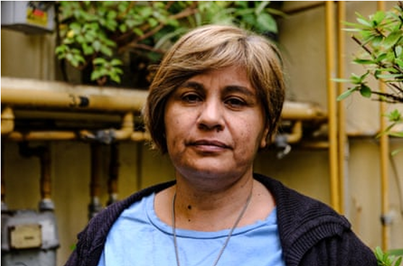
Martínez, along with dozens of other women in Argentina, has accused Opus Dei – which has a presence in more than 70 countries but is strongest in Spain, Italy and Latin America – of coercing them as children and adolescents into a life of domestic servitude.
Andrea Martínez says she was put to work at once by Opus Dei: ‘My mother left and I was given my schedule. We worked nine hours a day, seven days a week.’ Photograph: Harriet Barber
They say they were forced into working up to 12-hour days, cooking and cleaning for the elite members, without pay.
The women also say they faced extreme control, their letters were censored, and they were banned from reading anything but children’s books or religious texts. When they eventually escaped, the women say they were left without money, clothes or qualifications.
They said there was no other option for me – I was too poor, I had no man to marry; if I didn’t join, my family would be condemned to hell
Andrea Martínez
After a two-year investigation, Argentinian federal prosecutors have taken on their case, accusing senior leaders of Opus Dei in South America of overseeing the exploitation and trafficking of girls, adolescents and women between 1972 and 2015. The prosecutors’ report is now before a judge, who will decide whether to proceed to trial.
Opus Dei has categorically denied the accusations and says they have been taken “completely out of context”.
The prosecutors have alleged that Opus Dei (“Work of God” in Latin) established a structure dedicated to recruiting girls from poor rural families, which they said took “advantage of their extreme vulnerability”.

A portrait of Escrivá at St Eugene, Rome, a church built by the controversial wartime pope, Pius XII, and Opus Dei’s main church. Escrivá was canonised in 2002. Photograph: Gamma-Rapho/Getty.
(Note by Charles: Pious XII remained ignominiously silent during the Holocaust and WWII, showing total moral cowardice. He even knew of, and did nothing about, Catholic Extermination Camps in Croatia, run by a Franciscan friar, and also his friend and regular visitor, the Catholic Ante Paveliç, in which half a million orthodox christians (and a smaller number of Jews) were murdered by Francescian friers and their helpers).
In 1979, members of Opus Dei visited Claudia Carrero’s family and gave the then 13-year-old a prayer card of Josemaría Escrivá, the organisation’s founder, who was canonised in 2002. “We led a quiet, religious life,” she says. “My father was a labourer and my mother a housewife.
They tried to keep them like little children. They justify all of this by saying that it is ‘a decision from God’
Sebastián Sal
“Opus Dei said that if I came to the school, I would learn about hotel management and that I would get to travel. I was excited, but they did not take me there to study,” she says, “but to work.”
The school Martínez was sent to was several hours from her parents’ house. She remembers being put to work the day she arrived, along with dozens of other children. “My mother left and I was given my schedule.
“We worked nine hours a day, seven days a week, washing the clothes and preparing the food of senior male members. We only had three hours of school a day.”
The organisation succeeded, the women say, because the girls were kept isolated and docile, allowed only one phone call and letter home a month.
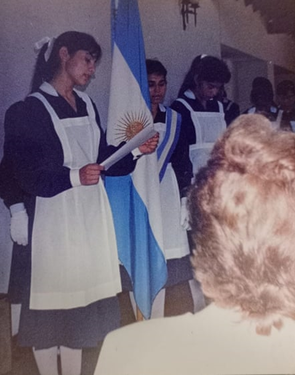
Andrea Martinez, front left, at Opus Dei. ‘The only texts we were allowed to read were children’s books or religious studies.’ Photograph: Andrea Martinez
“From the very beginning, I was told that I couldn’t say anything about Opus Dei, or what was happening, to my parents. We were told, always, to be obedient and docile,” she says.
“They would only send my letters if they thought what I had written was acceptable. I was cut off from the outside world,” she adds.
Sebastián Sal, the women’s lawyer, alleges that the “vocational schools” were a “seedbed” for Opus Dei. “They tried to keep them like little children,” Sal says. “They justify all of this by saying that it is ‘a decision from God’.”
After four years at the “school”, Martínez says she was forced to become a numerary assistant – essentially, Opus Dei’s domestic servants, who had to devote themselves to cooking and cleaning for the senior members and priests, while living a life of celibacy.
Despite wanting to study psychology, she says she was told that: “There was no other option for me, that I was too poor, that I had no man to marry; that if I didn’t join, my family would be condemned to hell.”
Afterwards, Martínez says her work increased to upwards of 12 hours a day, and she was given a cilice to wear around her upper thigh for two hours a day as a penance, and a small whip made of rope with which to flagellate herself while praying.
“The only texts we were allowed to read were children’s books or religious studies. There was no more school. I was trapped,” she says.
At 17, Carrero says, they also put pressure on her to become a numerary assistant: “They said that I had nobody to marry, that this was my destiny.”

Lucía Giménez, left, Alicia Torancio and Beatriz Delgado, who are among 43 former Opus Dei domestic workers whose case was taken up by prosecutors. Photograph: Natacha Pisarenko/AP
Every detail of her life was controlled, she says, from her clothes to visiting her parents. “I was not allowed to spend Christmas with my family or attend my grandmother’s funeral. Often, they denied our requests, telling us to ‘offer it up’ as a sacrifice to God. They hid behind God to use us.”
Carrero, like the other women, says she was regularly moved between residences, which she believes was to prevent them forming strong friendships. “I was moved many times from cities to cities, countries to countries – Paraguay, Uruguay – with no choice,” she says.

Claudia Carrero when she lived at Opus Dei. She says meeting the other women brought her peace. Photograph: Claudia Carrero
Martínez says she spent 10 years with Opus Dei before escaping. When she left, she had only 10 pesos (equivalent to a few dollars), no normal clothes and discovered that the educational certificates she had been issued by Opus Dei were not recognised.
“I had never received a salary. I didn’t know how to use money, how to speak to people. I was 23 but acted like a child of 12,” she says.
Argentinian prosecutors have alleged that at least 43 women, “most of them girls and adolescents”, were “subjected to living conditions comparable to servitude” and “trapped in a cycle of exploitation and abuse”.
There was “a complete lack of fair pay and basic rights, all under the pretext of ‘dedication’ and ‘spiritual salvation’,” say the prosecutors, who have requested that four former heads of Opus Dei in Argentina be summoned for questioning.
In a statement on its website, Opus Dei has said the schools were approved by the Argentinian authorities and that allegations that the girls were coerced into joining the organisation on promises of education are “false and misleading”.
It said the “spiritual vocation” of numerary assistant was “freely chosen”, that there was “no barrier to leaving” and that “numerary auxiliaries” must reaffirm their desire to be a member multiple times over several years. It also claims that the women received remuneration for their work.
The women have criticised the Catholic organisation’s response. They are demanding financial compensation, an acknowledgment of their suffering and a formal apology. “We want Opus Dei to accept what they have done and recognise its impact,” says Martínez.
Today, Martínez is studying psychology, while Delgado has recently completed secondary school, “only 40 years late,” she says.
Carrero has married and has a teenage daughter. She says meeting the other 42 women has brought her peace. “At last,” she says, “I am free.”
Harriet Barber in Buenos Aires
Mon 14 Apr 2025 06.00 BST